Spa Connect
2°
Springs & pouhons

Springs & pouhons

The water that gave its name to all spas in the world

Ferruginous and naturally sparkling, the waters of Spa spring forth in pouhons — from the Walloon « poujhî », to draw — where people have come to drink since the 16th century. Peter the Great or Joseph II have dipped their lips there. Tour the springs and check them off in your passport.

The springs

Pouhon Pierre-le-Grand

Place Pierre le Grand · city center

The historic heart of Spa: the place called « Spa » from the 14th century was this water source. Victor Besme's octagonal kiosk (1880), restored from 2009 to 2012, houses the tourist office and the winter garden where the Golden Book is exhibited, a nearly 9-meter canvas by Antoi

Pouhon Prince de Condé

Rue Jean Gérardy · next to the Pierre-le-Grand

Water even more mineralized than that of the Pierre-le-Grand, sparkling in two black marble basins. Pharmacist Schaltin dug a well there in 1863 and exported it, much to the dismay of the communal springs; the city bought it back in 1903. The 1879 drinking hall hides an artificia

Géronstère

Bérinzenne Estate · in the forest

Nicknamed « l'Enragée » (the Raging One) for its effects, its iron-tasting water had to be drunk on site. Mentioned as early as 1559, in 1651 it received from the Count of Burgsdorff a marble niche under a dome supported by four red marble pillars. Peter the Great drank there on

Barisart

Rue de Barisart · towards Géronstère

Mentioned in 1438 under the name « Barisair », it was, regulars said, the most sparkling and the best preserved. Abandoned at the beginning of the 19th century, it was rehabilitated and received a pavilion in 1859 that served as an inn. A romantic 19th-century grotto and a promen

Tonnelet

Nivezé

Its name is said to come from the small barrels that collected the water. Mentioned in 1559 as « source de la Frayneuse », it was exploited from the beginning of the 17th century, then brought back into prominence in 1753 with nearby baths. Too far from the center, it lost its sp

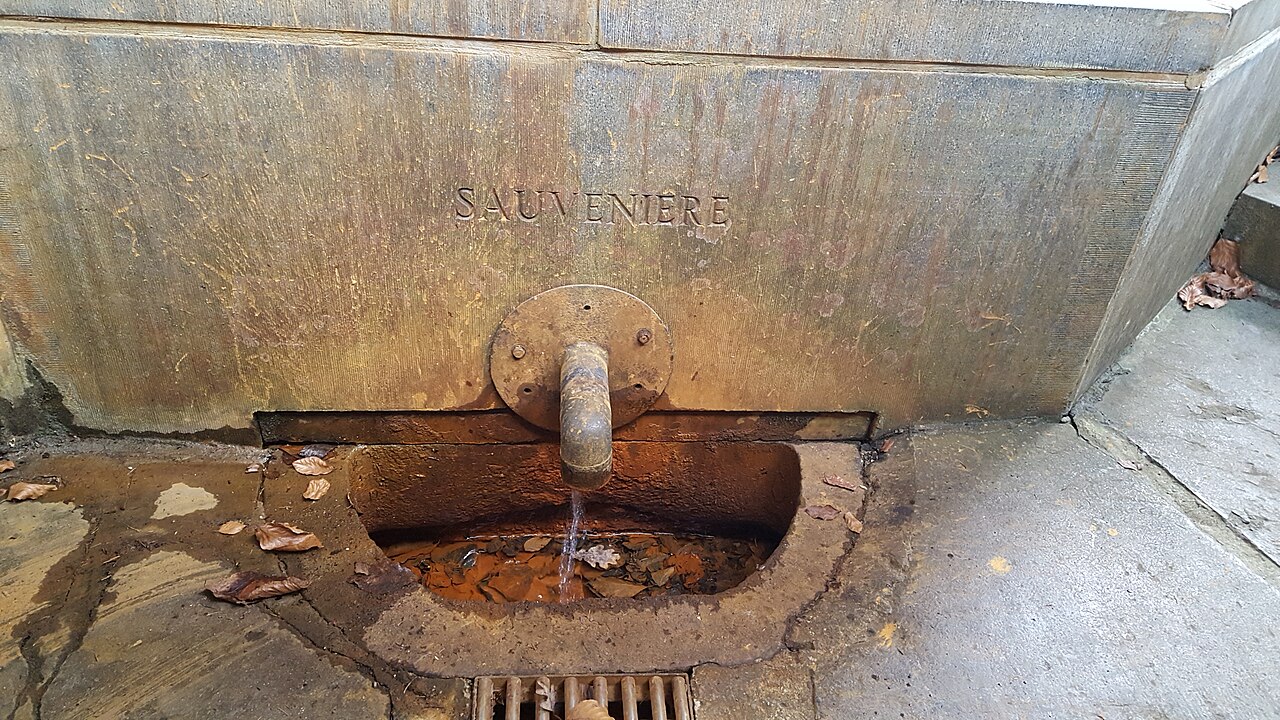
Sauvenière

Route de la Sauvenière · under the airfield

The oldest: Saint Remaclus is said to have discovered it in the 7th century. In a stone, the imprint of his sandal is shown: drinking the water while placing one's foot on it would make one fertile, and the spring has become a place of pilgrimage. Almost dried up by an earthquake

Groesbeek

A few steps from the Sauvenière

A few meters from the Sauvenière, the niche erected in 1651 by Baron Paul Jean de Groesbeek, Archdeacon of Condroz, bears his coat of arms and the inscription « ANNO 1651 ». Restored in 1776 and then in 1964. Nicknamed « Péquet » for its diuretic properties, a glass was drunk aft

Queen's Spring

Gérard Crehay Walk · in the forest

In the forest, about 200 m from the N62 and 500 m south of La Sauvenière, below the aerodrome. The pavilion, built in 1921–1922 and inaugurated on June 15, 1933, by Queen Elisabeth, is named after Queen Marie-Henriette. Its water, very lightly mineralized, flows through the peat

Pouhon Pia

Chemin des Fontaines

A small semi-cylindrical fountain from the Géronstère after the 1893 fire, in the forest about 150 m from the Chemin des Fontaines, at an altitude of about 435 m, on the bank of the Ruisseau des Pendus.

Aux Armes d'Autriche

Place Royale · at the foot of the funicular

First located in Vieux-Spa, near the inn of the same name, this fountain was dismantled in 2013 and then reassembled in 2018 at Place Royale, at the foot of the funicular. Its water leaves a characteristic red deposit.

Pouhon Delcor

Promenade de Dolez · on the GR5

A pouhon in the forest, near the arboretum, well-known by the people of Spa.

Did you know?